Advances in neural rhythms modulation and dysregulation
January 12-13, 2017

Advances in neural rhythms modulation and dysregulation
January 12-13, 2017

Estimado Miembro de la Comunidad de la Facultad de Ciencias:
La Facultad de Ciencias de la Universidad de Chile lamenta el sensible fallecimiento del académico del Departamento de Biología, Dr. Mario Luxoro Mariani, Profesor Titular de nuestra Casa de Estudios, Decano de la Facultad de Ciencias (1968-1972), Director de la Escuela de Postgrado (1996-2002) y Premio Nacional de Ciencias año 2000.
Nuestra comunidad universitaria hace extensivas sus más sentidas condolencias a su familia, colegas y amigos.
Sus restos serán velados en el Edificio Biología Milenio.
Trayectoria académica del Dr. Mario Luxoro Mariani:
El Dr. Mario Luxoro Mariani obtuvo en 1948 el título de Ingeniero Civil Químico en la Universidad Técnica Federico Santa María. Luego ingresó a la Escuela de Medicina de la Universidad de Chile motivado por su interés en las Ciencias Biológicas.
Con la beca Rockefeller y para extender su formación en el área de la Biología Cuantitativa, ingresó como estudiante de doctorado al Massachusetts Institute of Technolgy (MIT) de los Estados Unidos, donde obtuvo el grado de doctor en 1957, convirtiéndose en el primer chileno en doctorarse en el extranjero.
Posteriormente siendo académico de la Facultad de Medicina de la Universidad de Chile, el Prof. Luxoro impulsó y participó junto a otros destacados académicos en la creación de la Facultad de Ciencias y del Laboratorio de Fisiología Celular de Montemar, en Viña del Mar.
Iniciador de la Escuela de Biofísica en Chile, el Dr. Mario Luxoro fue autor de importantes y numerosas publicaciones científicas. Se le reconoce además su labor en la formación de científicos en el campo de la Fisiología Celular y Neurociencia.
Informamos a usted que los restos mortales del Dr. Mario Luxoro M., están siendo velados en el Auditorio del Edificio Biología Milenio, sus funerales se realizaran mañana miércoles 28 de diciembre a las 16:00 hrs, en el cinerario Parque del Recuerdo, Huechuraba (entre Recoleta con Vespucio).

We seek a highly-motivated individual who enjoys the freedom to pursue their own ideas in a supportive environment to join our team. Our goal is to understand and control neural function with the purpose of restoring function to individuals with neurological impairment or disease.
Presently we have active projects in
We conduct computer-based modeling of neurons and electric fields, in vivo stimulation and recording in pre-clinical models, and translational clinical feasibility / physiology experiments in humans. The strong interdisciplinary and collaborative environment at Duke is ideal for our translational research efforts.
The focus of this position is on experimental and computational studies to understand mechanisms and innovations to increase therapeutic efficacy of spinal cord stimulation and deep brain stimulation.
This is a full-time position with University Benefits and provides exceptional opportunities for interdisciplinary research and career development. An earned PhD and previous experience in experimental electrophysiology are required, as are excellent communication skills. Previous computational modeling experience is beneficial.
For consideration submit a CV and the names and contact information of three professional references as a .pdf file attachment to:
Warren M. Grill, Ph.D.
Professor of Biomedical Engineering
warren.grill@duke.edu
Duke University is an equal opportunity / affirmative action employer.
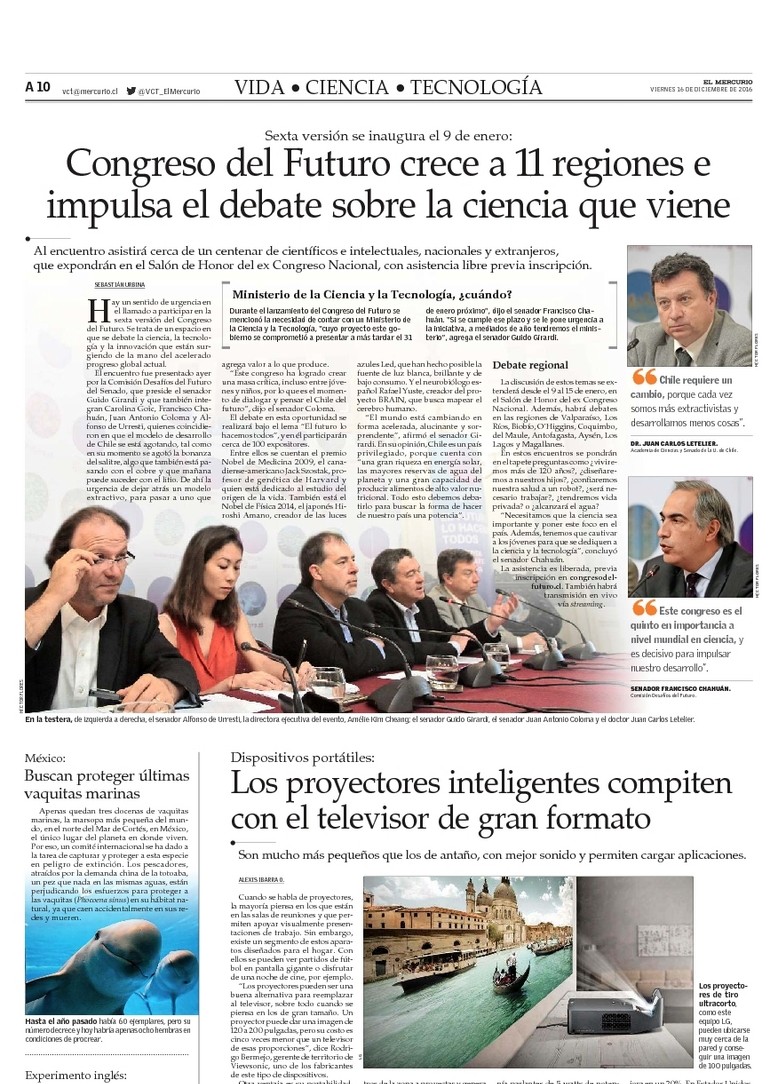
Fuente: El Mercurio

Universidad Autónoma de Chile
Pedro de Valdivia 425, Providencia.
Registration: goo.gl/hr1svx
Two postdoctoral positions to study the cognitive consequences of age-related hearing loss and stress are available at the auditory and cognition center (AUCO). These postdoctoral positions are funded by the project “From Presbycusis to Dementia. A basic and clinical approach” from the PIA-CONICYT program: Anillo de Investigacion en Ciencia ACT1403. This collaborative project includes three laboratories directed by Paul Delano (Universidad de Chile), Carolina Delgado, (Universidad de Chile) and Alexies Dagnino (Universidad de Valparaiso). (www.auco.cl)
In particular, the first eligible postdoctoral researcher will analyze brain-imaging data with magnetic resonance. In addition, the postdoctoral researcher will have to analyze cognitive, behavioral and audiological data from human subjects, including controls and presbycusis patients at the Clinical Hospital of the Universidad de Chile in Santiago, Chile.
The second eligible postdoctoral position to study the cognitive consequences of stress is available at the auditory and cognition center (AUCO). We use rodent models to elucidate the mechanisms by which stress leads to psychiatric and medical disorders including dementia and depression. Specific interests include elucidating the basis of the impact of chronic stress on neural circuit that modulates auditory attention during adulthood and aging. Our approaches span from basic histology to in vivo recording in behaving rats. In particular, the eligible postdoctoral researcher will perform in vivo recording in the auditory cortex of stressed rats during an attentional task at Dr. Dagnino Lab (www.stress.cl).
The postdoctoral researchers must have full availability (44 h per week), and the expected beginning of this postdoctoral position is on March 1th, 2017. The offered salary is 1,200,000 CLP monthly, for one year renewable for another year, depending on the evaluation performed by the principal investigators.
Send an email with your CV and cover letter to: phdelano@gmail.com; carodede@gmail.com and alexies.dagnino@uv.cl including the contact information of two references. Application deadline: 31th December, 2016. The non-selected and selected applicants will be informed by email near 15th January, 2017. Granted postdoctoral fellows at the AUCO center are expected to apply with the principal investigators of the AUCO center in May 2017 for postdoctoral Fondecyt funding.
(http://www.conicyt.cl/fondecyt/category/concursos/postdoctorado/)

 The Latin American Training Program is a comprehensive, yearlong online program that provides a unique training opportunity for young investigators from across Latin America and the Caribbean.
SfN is pleased to offer the fourth year of the program consisting of webinars, recorded content, and online discussions which incorporate cutting edge science and professional development topics. Support for LATP is provided by The Grass Foundation, the Latin American Regional Committee of the International Brain Research Organization (IBRO), US/Canada Regional Committee (US/CRC) of IBRO, and the selected host institution.
Fifteen selected trainees from the program will also participate in a three-week course from March 20 – April 7, 2017 at the Universidad de Valle in Cali, Colombia. The course topic is, “Signal processing: from single molecules to brain circuits.” The course will bring together top faculty from across the region and the world to provide participants with high-quality lectures, lab exercises, and training on vital professional development topics.
View the course preliminary program here.
