/

Circular 2 – Reunión anual Sociedad Chilena de Neurociencia

Estimado(a) Socio(a):

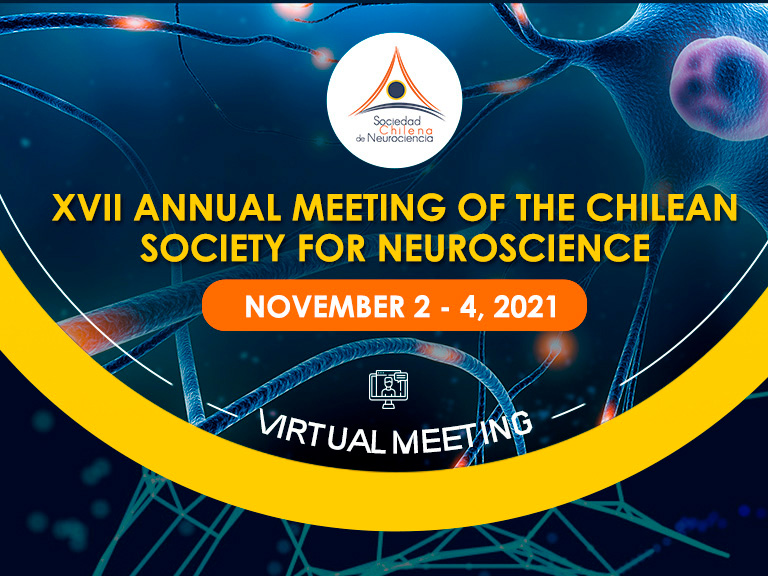
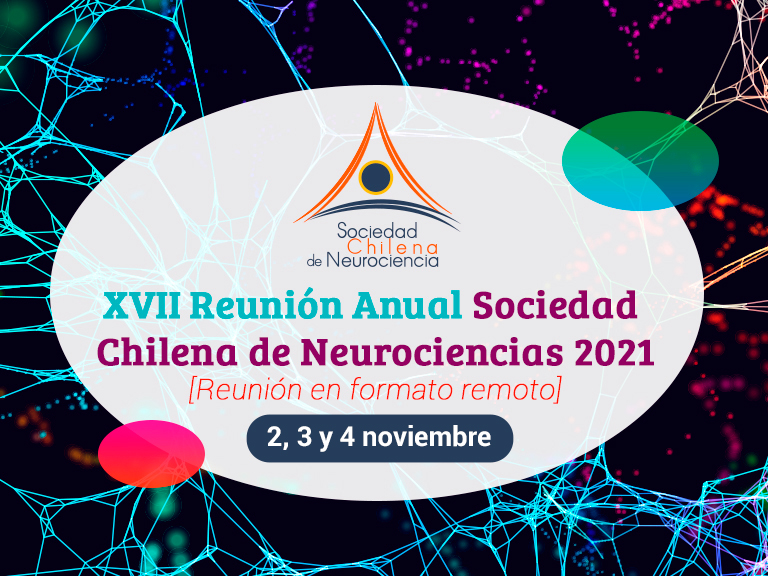
Tenemos el agrado de enviar el segundo comunicado acerca de la XVII Reunión Anual de nuestra Sociedad, que tendrá lugar en formato remoto.

Esperamos contar con su participación y la de sus estudiantes, la que sin duda contribuirá a dar realce a nuestra XVII Reunión Anual.

El idioma oficial de este congreso será el inglés, por lo que los resúmenes y paneles deben ser escritos y presentados en ese idioma.

En relación a las comunicaciones libres se sugiere indicar el modo de presentación (oral o poster). Sin embargo, el Comité Organizador definirá finalmente la modalidad de presentación.

PLAZO PARA RECEPCIÓN DE LOS RESÚMENES

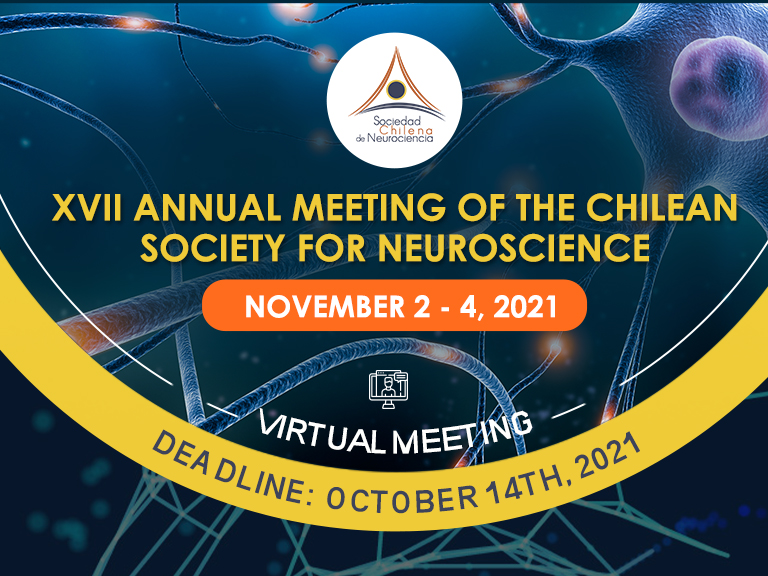
Comunicaciones Libres, Poster, Conferencias y Simposios: 14 de octubre

El resumen se debe enviar a la plataforma que se habilitará a partir del 27 de  septiembre en  https://play.4id.science/neuroc6

COSTOS DE INSCRIPCIÓN Y ENVÍO DE RESÚMENES

Simposiantes y conferencistas internacionales: Liberados  de pago

Estudiantes de pre y postgrado: Liberados de pago

Socios e Investigadores postdoctorales: $20.000 |  US$28

No socios: $30.000 | US$40                     

Resúmenes:  $15.000 US$20

Existirá una modalidad de registro “LABORATORIO” que permitirán incluir número ilimitado de participantes y resúmenes (del mismo laboratorio) por un costo de $120.000 (US$ 160)

PROGRAMA

Symposia

1.- Rare genetic diseases and their impact on neurodevelopment and CNS function.

Coordinator: Maria Paz Marzolo

  1. Victor Faundez, “Systems Biology of rare neurological disorders”. Department of Cell Biology, Emory University, Atlanta, USA.
  2. Bredford Kerr, “Environmental enrichment as a bypass to attenuate the progression of Rett syndrome-like phenotype in a mouse model of the disease”. Centro de Biología Celular y Biomedicina. Facultad de Medicina y Ciencia. Universidad San Sebastián, Chile.
  3. María-Paz Marzolo, “The AP-4 adaptor complex, mutated in Hereditary Spastic Paraplegia, has ApoER2 as a new cargo with relevant neuronal functionsDepartment of Cell and Molecular Biology. Faculty of Biological Sciences. Pontificia Universidad Católica de Chile, Chile.
  4. Hugo J Bellen, “Fly tools and approaches to study neurological rare and common human diseases”. Departments of Molecular and Human Genetics and Neuroscience. Texas Children Hospital. Baylor College of Medicine, USA.

2.- Ecological Cognitive Neuroscience: moving towards real-life Science.

Coordinator: Rodrigo Montefusco; María de los Ángeles Juricic

  1. Rodrigo Montefusco, “How valid are our experimental conclusions in real life?”. Faculty of Medicine, Center for Interdisciplinary Studies on Nervous System (CISNe). Universidad Austral de Chile. Chile.
  2. Paul Matusz, “Bridging past and future in education: Integrating multisensory models of brain and cognition with naturalistic laboratory research”. Hearing & Speech Sciences, Vanderbilt University, Nashville, TN, USA
  3. Jacqueline Snow, “Why realism is important for understanding human brain and behavior”. Department of Psychology at the University of Nevada, Reno. USA.
  4. Francisco J. Parada, “MoBI meets 4E cognition: getting ready for real-world neuroscience”. Facultad de Psicología, Universidad Diego Portales. Chile.

3.- Microexons and Central Nervous System Development.

Coordinator: Maria Estela Andres / Paola Haeger

  1. Manuel Irimia., “Parallel evolution of neural microexons in insects and vertebrates”. Centre for Genomic Regulation, Barcelona Institute of Science and Technology, Barcelona. España.
  2. Paola Haeger, “Cognitive impairment induced by prenatal ethanol exposition: New

insights into gene expression dysregulation”. Departamento de Ciencias Biomédicas, Facultad De Medicina, Universidad Católica Del Norte, Coquimbo, Chile.

  1. Elena Battaglioli, “Microexon contribution to environmental-stress adaptation: the

interesting case of LSD1”. Department of Medical Biotechnology and Translational

Medicine, Università degli Studi di Milano-Via Fratelli Milano. Italy.

4.- Mente, Cerebro y Educación.

Coordinator: Paulo Barraza

  1. Elena Salillas, “Redes cerebrales tras la aritmética simple: evidencia de magnetoencefalografía”. Universidad de Zaragoza, España.
  2. Marcela Peña, “Tecnologías interactivas para apoyar el desarrollo del lenguaje en pre-escolares”. Pontificia Universidad Católica de Chile, Chile.
  3. Cecilia Calero, “Enseñar… ¿Cómo y para qué?”. Universidad Torcuato Di Tella, Argentina.
  4. Paulo Barraza, “El Cerebro del Profesor: bases neurocognitivas de la docencia experta”. Universidad de Chile, Chile.

5.- Young Neuroscientist Symposium.

Coordinator: Patricio Orio

6.- Brain aging and glial cells – When neuroinflammation shapes brain function.

Coordinator: Maite Castro / Francisco J. Rivera

  1. Flavia E. Saravia, “Microglia in the context of aging and Alzheimer’s disease”. Faculty of Exact & Natural Sciences, University of Buenos Aires. Argentina.
  2. Ludwig Aigner, “Targeting Brain Rejuvenation for the Treatment of Dementia”. Spinal Cord Injury and Tissue Regeneration Center Salzburg (SCI-TReCS), Institute of Molecular Regenerative Medicine, Paracelsus Medical University Salzburg, Austria.
  3. Saul Villeda, “Systemic mechanisms of brain rejuvenation” Endowed Chair in Biomedical Sciences, School of Medicine, University of California, San Francisco. USA.

7.- Molecular basis of memory and depression.

Coordinator: Jimmy Stehberg

  1. Irit Akirav, “Targeting the endocannabinoid system in stress-related disorder”. Department of Psychology, Haifa University, Haifa. Israel
  2. Aline Desmedt, “A molecular switch in the transition from normal to PTSD-like fear memory”. Neurocentre Magendie, INSERM U1215. Bordeaux University. France.
  3. Jimmy Stehberg., “Role of astrocytes in memory and depression”. Instituto de Ciencias Biomédicas, Universidad Andrés Bello, Santiago. Chile.
  4. Kobi Rosemblum. “New inhibitors for QR2 to fight neurodegeneration and AD”. Sagol Dept Neurobiology, University of Haifa. Israel.

Conference 1

Benno Roozendaal, Donders Institute. Radboud University Medical Center. Nijmegen. The Netherlands.

Title: Stress hormone effects on different aspects of memory quality.

Coordinator: Jimmy Stehberg

Conference 2

Casper Hoogenraad, Genetech, USA.

Title: Building a neuron: cytoskeleton organization and transport mechanisms’

Coordinator: Christian Gonzalez

Roundtable

Coordinator: Christian Gonzalez

“Humberto Maturana (1928-2021): Una visión sistémica de los seres vivos”

Jorge Mpodozis, “Evolución a través de la deriva del Nicho Ontológico”. Departamento de Biología, Facultad de Ciencias, Universidad de Chile.

Juan-Carlos Letelier, “Algo Necesario para entender la génesis del concepto de Autopoiesis: Las interacciones entre Humberto Maturana y Heinz von-Foerster (1963-2002)”. Departamento de Biología, Facultad de Ciencias, Universidad de Chile.

Maria de la Luz Cardenas: “Autopoiesis y Metabolismo”. Bioénergétique et Ingénierie des Protéines, Centre National de la Recherche Scientifique (CNRS), Marseilles, France.

Para mayores informaciones en:   https://socneurociencia.cl/

Atentos saludos,
COMITÉ ORGANIZADOR

/

Se extiende plazo hasta el 30 de septiembre para postular YNS-call-2021

The Sociedad Chilena de Neurociencias (SCN) invites PhD students, postdocs and young researchers at initial career stages to participate in the “Young Neuroscientists Symposium” of the Congress. Applicants to this special symposium will be selected by competition, according to their scientific merits.

Bases:

  • There are four slots available. Selected applicants will be invited to present their work in our remote meeting. All selected participants will receive a registration and abstract fee
  • The awardees must attend the entire congress and hold their talk in
  • Up to two of the slots will be awarded to applicants with residence out of The remaining slots will be given to applicants from Chile.
  • Only one applicant from the same laboratory or research group can be

Applicants need to submit the following documentation:

  1. An English abstract describing the work to be presented (max. 250 words).
  2. A brief curriculum vitae including: Full name, nationality, date and place of birth, country of residence, affiliation, education, research experience, publications, meeting presentations and other relevant
  3. An informal letter of reference from the thesis advisor, postdoctoral supervisor or head of department.

Application deadline: September 30th, 2021.

Applications must be sent to sociedadchilenaneurociencia@gmail.com. Subject: “YNS 2021”.

For inquiries, contact jlvaldes@uchile.cl

/

Call for participation in the Young Neuroscientists Symposium – Plazo 12 de septiembre

The Sociedad Chilena de Neurociencias (SCN) invites PhD students, postdocs and young researchers at initial career stages to participate in the “Young Neuroscientists Symposium” of the Congress. Applicants to this special symposium will be selected by competition, according to their scientific merits.

Bases:

  • There are four slots available. Selected applicants will be invited to present their work in our remote meeting. All selected participants will receive a registration and abstract fee
  • The awardees must attend the entire congress and hold their talk in
  • Up to two of the slots will be awarded to applicants with residence out of The remaining slots will be given to applicants from Chile.
  • Only one applicant from the same laboratory or research group can be

Applicants need to submit the following documentation:

  1. An English abstract describing the work to be presented (max. 250 words).
  2. A brief curriculum vitae including: Full name, nationality, date and place of birth, country of residence, affiliation, education, research experience, publications, meeting presentations and other relevant
  3. An informal letter of reference from the thesis advisor, postdoctoral supervisor or head of department.

Application deadline: September 12th, 2021.

Applications must be sent to sociedadchilenaneurociencia@gmail.com. Subject: “YNS 2021”.

For inquiries, contact jlvaldes@uchile.cl

/

Postdoctoral Research Associate Wanted

Segev Lab
Dept. of Biochemistry and Molecular Genetics
College of Medicine
University of Illinois at Chicago

Our lab addresses questions about intracellular trafficking important for human diseases ranging from cancer to neurological disorders

Contact us if you want to join our group of motivated scientists, well resourced, in an exciting environment, funded by NIH

Recent topics and publications include:

  • Regulation of secretion, endocytosis and autophagy by Rab GTPases (PLoS Genet, 2020; JCB, 2019; PLoS Genet, 2017; Dev Cell, 2016)
  • Yeast modeling of neurodevelopmental genetic disorders (Brain, 2020; Autophagy, 2020)

Presentations in international meetings include ASCB-EMBO, FASEB and FEBS

Applicants must possess a PhD and demonstrate experience in cell biology, biochemistry or molecular biology.

The position is available immediately (August 2021)

For consideration, email your CV, a brief summary of research experience and three references to Dr. Nava Segev (nava@uic.edu)

The University of Illinois at Chicago is an Equal Opportunity, Affirmative Action employer.  Minorities, women, veterans and individuals with disabilities are encouraged to apply. 
  
The University of Illinois may conduct background checks on all job candidates upon acceptance of a contingent offer. Background checks will be performed in compliance with the Fair Credit Reporting Act. 
  
The University of Illinois System requires candidates selected for hire to disclose any documented finding of sexual misconduct or sexual harassment and to authorize inquiries to current and former employers regarding findings of sexual misconduct or sexual harassment. For more information, visit https://www.hr.uillinois.edu/cms/One.aspx?portalId=4292&pageId=1411899

/

Call for participation in the Young Neuroscientists Symposium

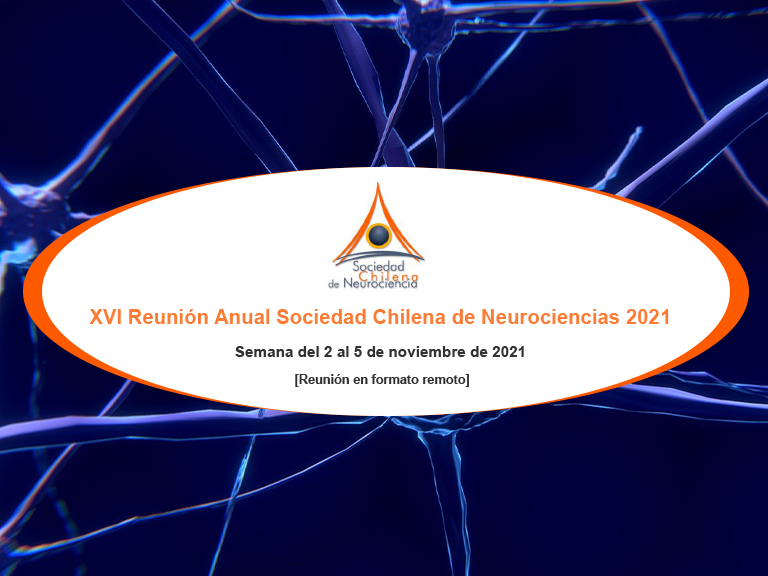
XVI Reunión Anual Sociedad Chilena de Neurociencias 2021 Semana del 2 al 5 de noviembre de 2021 [Reunión en formato remoto]

CALL FOR PARTICIPATION IN THE YOUNG NEUROSCIENTISTS SYMPOSIUM

The Sociedad Chilena de Neurociencias (SCN) invites PhD students, postdocs and young researchers at initial career stages to participate in the “Young Neuroscientists Symposium” of the Congress. Applicants to this special symposium will be selected by competition, according to their scientific merits.

Bases:

  1. There are four slots available. Selected applicants will be invited to present their work in our remote meeting. All selected participants will receive a registration and abstract fee waiver.
  2. The awardees must attend the entire congress and hold their talk in English.
  3. Up to two of the slots will be awarded to applicants with residence out of Chile. The remaining slots will be given to applicants from Chile.
  4. Only one applicant from the same laboratory or research group can be selected.

Applicants need to submit the following documentation:

  • An English abstract describing the work to be presented (max. 250 words).
  • A brief curriculum vitae including: Full name, nationality, date and place of birth, country of residence, affiliation, education, research experience, publications, meeting presentations and other relevant information.
  • An informal letter of reference from the thesis advisor, postdoctoral supervisor or head of department.

Application deadline: September 12th, 2021.
Applications must be sent to sociedadchilenaneurociencia@gmail.com. Subject: “YNS 2021”.
For inquiries, contact jlvaldes@uchile.cl

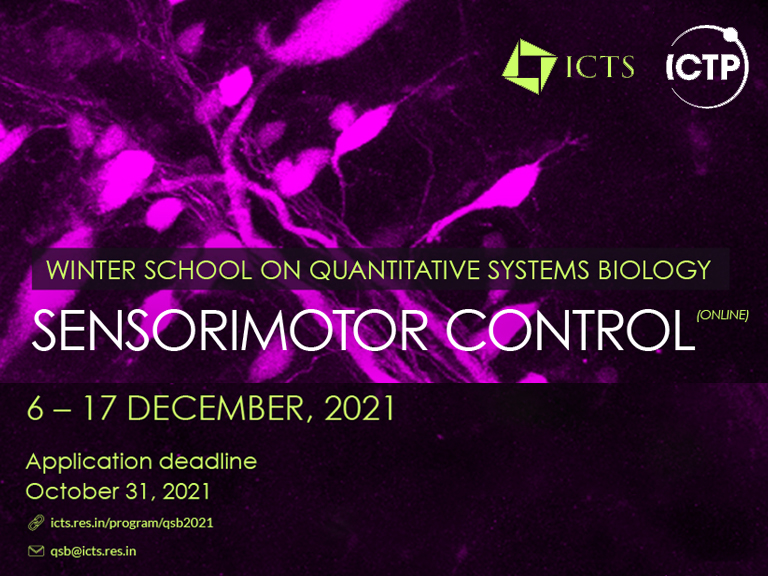
Applications invited for ICTP-ICTS Winter School on Quantitative Systems Biology (ONLINE)

Dear Colleague,

The International Centre for Theoretical Sciences (ICTS-TIFR), Bangalore invites applications for the program “ICTP-ICTS Winter School on Quantitative Systems Biology (ONLINE)” scheduled to be held from 06 December 2021 to 17 December 2021 over zoom.

About the program:
This is the tenth school in the series on Quantitative Systems Biology, held alternately at Trieste and Bangalore. The school responds to the strong need, especially at the Ph.D. and postdoc level, for providing scientists with a broad exposure to quantitative problems in the study of living systems. The audience will range from Ph.D. students to young faculty, who either work in this area or plan to do so.

For more information kindly visit the program web page: https://www.icts.res.in/program/qsb2021

Eligibility Criteria:
Scientists, postdocs and students from all over the world can apply for the School. Researchers from developing countries are particularly encouraged to apply. As the program will be conducted in English, participants should have an adequate working knowledge of this language.

How to Apply:

There is no registration fee. Interested applicants should apply online –https://register.icts.res.in/program/qsb2021

The application deadline iOctober 31, 2021

Poster link:
https://www.icts.res.in/sites/default/files/media/program/poster/282_Winter%20school%20QSBio-01%20%281%29.png

Contact: qsb@icts.res.in

/

CfP LAWCN’21 – III Latin-American Workshop on Computational Neuroscience (Deadline: August 16th, 2021)

CALL FOR PAPERS 
III LATIN-AMERICAN WORKSHOP ON COMPUTATIONAL NEUROSCIENCE (LAWCN’21) – December 8-10, 2021
Paper Submission DeadlineAugust 16th2021 
HYBRID EVENT: VIRTUAL AND PRESENTIAL
Federal University of Maranhão (UFMA), Av. dos Portugueses, 1966 – Vila Bacanga, 65080-805, São Luís, MA – Brazil
———————————————————————————
The LAWCN’21 aims to gather researchers with different backgrounds – medicine, psychology, electrical engineering, biomedical engineering, mechanical engineering, computer science, mathematics, physics and so on –  to  better understand the brain. Scientists from Latin-American and around the world are welcome to submit their results and ideas as papers to be presented at the conference. Its main areas are: i) Computational Neuroscience; ii) Neuroscience; iii) Neuroengineering; iv) Artificial Intelligence and related topics.
 It is going to be a hybrid conference, i.e. face-to-face and online event, due to COVID-19 pandemic. Entertaining platforms are going to be used to promote interactive actions between local and remote participants.  It is expected, as in the previous editions, hundreds of scientists from undergrads to experienced faculties to attend interesting talks from renowned keynote speakers. We are proud to highlight that we have already secured the presence of six world-class scientists as keynote speakers: Peter Tass (Stanford University, USA)Alan Talevi (Universidad Nacional de La Plata, Argentina)André de Carvalho (University of São Paulo, Brazil)Kerstin Schimidt (Federal University of Rio Grande do Norte, Brazil)Jose C. Principe (University of Florida, USA) and Angela Wyse (Federal University of Rio Grande do Sul, Brazil). There are more under confirmation.
Participants are invited to submit papers on the topics of the event. All accepted papers will be published in the conference proceedings (with ISBN). Abstracts are also accepted and will be published online in the III LAWCN Proceedings (with ISBN). Moreover, as in last editions, it is planned to publish the selected papers of LAWCN 2021 in the Communications in Computer and Information Science (CCIS) proceedings series, Springer Nature, but approval is still pending. Papers will be evaluated based on their quality and significance by an international and experient program committee (https://www.lawcn.com.br/src/comittees.html).
Important Dates 
  • Paper submission deadlineAugust 162021 
  • Notification of acceptance (paper): September 30, 2021
  • Camera-ready (paper): October 31, 2021
  • Abstract submission deadline: September 27, 2021
  • Notification of acceptance (abstract): October 15, 2021
  • Camera-ready (abstract): October 31, 2021
Workshop: December 8-10, 2021 (UFMA, São Luís do Maranhão, Brazil and Online)
Some topics of the conference can be seen below. For a complete list of topics and further details about the submission see: https://www.lawcn.com.br/src/submissions.html

Computational Neuroscience

Neuroscience

Neuroengineering

Artificial Intelligence and related topics

  • Biophysically realistic models

  • Single-neuron modeling

  • Models of brain networks and circuits

  • Sensory processing

  • Development, axonal patterning, and guidance

  • Memory and synaptic plasticity

  • Sensory processing

  • Network dynamics

  • Reinforcement learning

  • Motivation and decision making

  • Statistical approaches in neuroscience

  • Systems neuroscience

  • Learning and memory

  • Large-scale recordings

  • Neural signal processing

  • Neuromodulation

  • Neuroprosthetics

  • Closed-loop systems

  • Neuromorphism

  • Neuro-robotics

  • Artificial Intelligence

  • Techniques in neuroscience

  • Bioinformatics

  • Clustering and applications

  • Computer vision, cognitive and humanoid vision

  • Data visualization and applications

  • Deep Learning

The III LAWCN (2021) has the financial support from the International Brain Research Organization (IBRO) and is going to provide travel aid for some participants, with a special focus on women and regional diversity.
The Organizing Committee is very proud to welcome researchers from Latin America and the whole world to the III LAWCN (2021). If you have any doubt, please do not hesitate to contact us: lawcn@ufma.br

View PDF